

How Does Deaf Education Compare To Oral Education
Oral Thrush Signs, Symptoms, and All-time Treatment for Thrush
Oral thrush, too called oral candidiasis, is the most common fungal infection of the mouth. It usually happens in people with weak or underdeveloped immune systems. It ofttimes presents with white lesions on the roof of the mouth, cheeks, and tongue. While the all-time treatment for thrush varies depending on the severity of symptoms and the person affected, antifungal medications are typically used to care for oral thrush. Read on to learn more virtually the signs, symptoms, and best treatment for oral thrush.
Oral thrush is a mouth infection usually acquired by a fungus called Candida albicans. Candida albicans is part of the normal flora of the oral fissure, significant that the fungus is normally present in the oral fissure and does non cause harm. However, sometimes it overgrows, leading to disease. A weakened immune organisation can atomic number 82 to this overgrowth. So, people with conditions that weaken the immune system, such as cancer or HIV/AIDS, are more likely to be afflicted. Infants are as well more probable to be affected by oral thrush than adults because their immune systems are not fully developed. If a breastfeeding babe has oral thrush, they can transmit the infection to their mother, passing it back and along betwixt mother and baby.
Other risk factors for oral thrush include:
- Poorly controlled diabetes: People with uncontrolled diabetes may have loftier saccharide levels in their saliva, which allows Candida albicans to grow
- Vaginal yeast infections: Infants built-in to mothers with vaginal yeast infections, or fungal infections of the vagina, can get thrush when they pass through their mother's birth canal.
- Employ of antibiotics: Antibiotics tin can wipe out normal flora of the rima oris, giving Candida albicans more than space to grow in backlog.
- Use of corticosteroids: Corticosteroids generally suppress the immune system, preventing immune cells from suppressing Candida albicans proliferation
- Smoking: Smoking can increase the chance of oral infection with Candida past drying out the mouth.
- Denture use: Denture utilize can increase the risk of oral infection with Candida past drying out the rima oris.
Oral thrush may spread to the esophagus, leading to a condition called esophageal candidiasis. Esophageal candidiasis is considered an "AIDS-defining affliction" considering it is ane of the almost common infections seen in people living with HIV/AIDS.
Signs and Symptoms
The following signs and symptoms may occur in people with oral thrush:
- White, raised lesions, typically on the tongue or cheeks, that look like cottage cheese
- Redness, burning, or pain that may make eating and swallowing difficult
- Cracks at the corners of the mouth (angular cheilitis)
- A cotton-like feeling in the mouth
- Loss of gustation (ageusia)
- Irritation and hurting under dentures (denture stomatitis)
In addition to these symptoms, if you have esophageal candidiasis, you may experience pain when swallowing (odynophagia) and difficulty swallowing (dysphagia).
Infants affected by oral thrush may exist fussier than normal and take difficulty feeding. Women whose breasts go infected with Candida from breastfeeding may experience unusual redness, flakiness, or hurting on the areola (the darker, circular expanse of the nipple). They may also feel deeper, stabbing pains of the breasts3.
Diagnosis
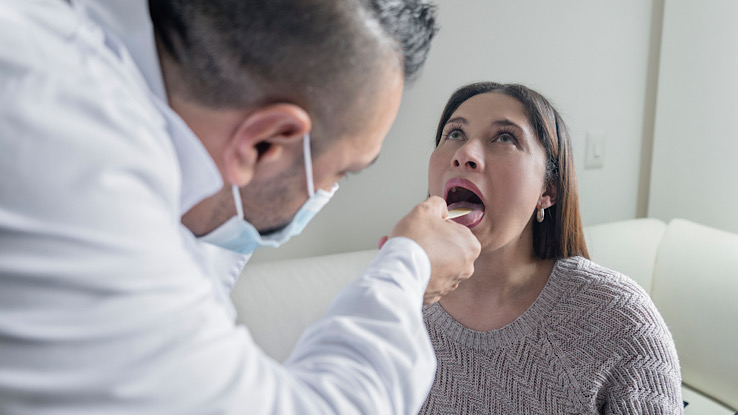
Doctors usually diagnose oral thrush by asking patients nigh their symptoms and examining the oral fissure for white lesions that can easily exist scraped away with a tongue depressor. Sometimes, they'll have a sample of the fungus from a patient's oral cavity to be examined nether a microscope in a laboratory. Nonetheless, people with astringent cases of oral thrush or those with esophageal candidiasis may undergo further testing to determine the underlying causes of their condition and the extent of their infection. These tests include:
- A complete blood count (CBC), which shows how well the immune arrangement responds to the infection.
- A biopsy, where a fungus sample is grown on a special medium to identify the microorganism causing the infection.
- An endoscopic exam, where the esophagus, stomach, and upper role of the small intestine (duodenum) are visualized with a camera-like device chosen an endoscope.
- A physical examination to see if other body parts are infected with Candida.
Treatment Options
The most effective treatment for thrush varies slightly depending on the severity of the symptoms and the patient.
Good for you Adults and Children
Mild cases of oral thrush in healthy adults and children are treated for one to two weeks with antifungal lozenges, tablets, liquids, or topical medication. Clotrimazole, miconazole, and nystatin are examples of antifungal medications that can exist used for this condition. Oral or intravenous fluconazole is used for moderate to astringent cases of oral thrush.
Infants and Nursing Mothers
Infants with oral thrush should be treated with miconazole gel or fluconazole. Breastfeeding females who take an infection of the breasts with Candida may be prescribed antifungal foam to utilise to afflicted areas.
People with Weakened Immune Systems
Oral fluconazole is the best handling for thrush in people with weak immune systems. Those with HIV/AIDS are too treated with antiretroviral therapy to prevent recurrent thrush infections. Esophageal candidiasis is treated with oral fluconazole for two to three weeks.
Overall, oral fluconazole tends to be the best thrush handling. While topical medication can be used for balmy cases of thrush, recurring infections are more probable to happen with topical antifungals than with oral fluconazole. In rare cases, fluconazole is not effective against cases of thrush, and a medication chosen amphotericin B is used instead.
Next Steps
There are a few elementary steps you can take to prevent oral thrush.
- Maintain good oral hygiene: Brush and floss your teeth regularly. Replace your toothbrush often until the thrush is gone, and never share your toothbrush with others.
- Keep your dentures clean: Enquire your dentist well-nigh how to keep your dentures clean and how to avoid reinfecting yourself with oral thrush.
- Rinse your rima oris with saltwater: Dissolve near ½ teaspoon of common salt in one loving cup of warm h2o. Swirl this h2o in your mouth and spit it out. Practise not swallow this water.
- Employ nursing pads: If you get a fungal infection from breastfeeding, use nursing pads to prevent the mucus from spreading to your clothing. Plastic can encourage the growth of Candida, so avert pads that take a plastic bulwark. Wear a clean bra daily. Inquire your md how to proceed breast nipples, bottle nipples, pacifiers, and chest pumps clean and gratuitous of the fungus.
If you think you might have thrush, inquire your doctor nigh your symptoms and what treatments are recommended.
Resource Links:
- "Candida infections of the mouth, pharynx, and esophagus" via CDC
- "Clinical and microbiological diagnosis of oral candidiasis" via Journal of Clinical and Experimental Dentistry
- "Oral Thrush" via Mayo Clinic
- "Candidiasis (Oropharyngeal)" via Clinical Evidence
- "Clinical Practice Guideline for the Management of Candidiasis: 2016 Update past the Infectious Diseases Order of America" via Clinical Infectious Affliction
- "Oropharyngeal Candidiasis in the Era of Antiretroviral Therapy" via Oral Surgical Oral Medicine Oral Pathology Oral Radiology and Endodontics
Source: https://www.thehealthfeed.com/health-conditions/oral-thrush-signs-symptoms-and-best-treatment-for-thrush?utm_content=params%3Ao%3D1668962%26ad%3DdirN%26qo%3DserpIndex&ueid=cdc0c289-09b0-486d-b2c3-4b7abc6156d2
0 Response to "How Does Deaf Education Compare To Oral Education"
Post a Comment